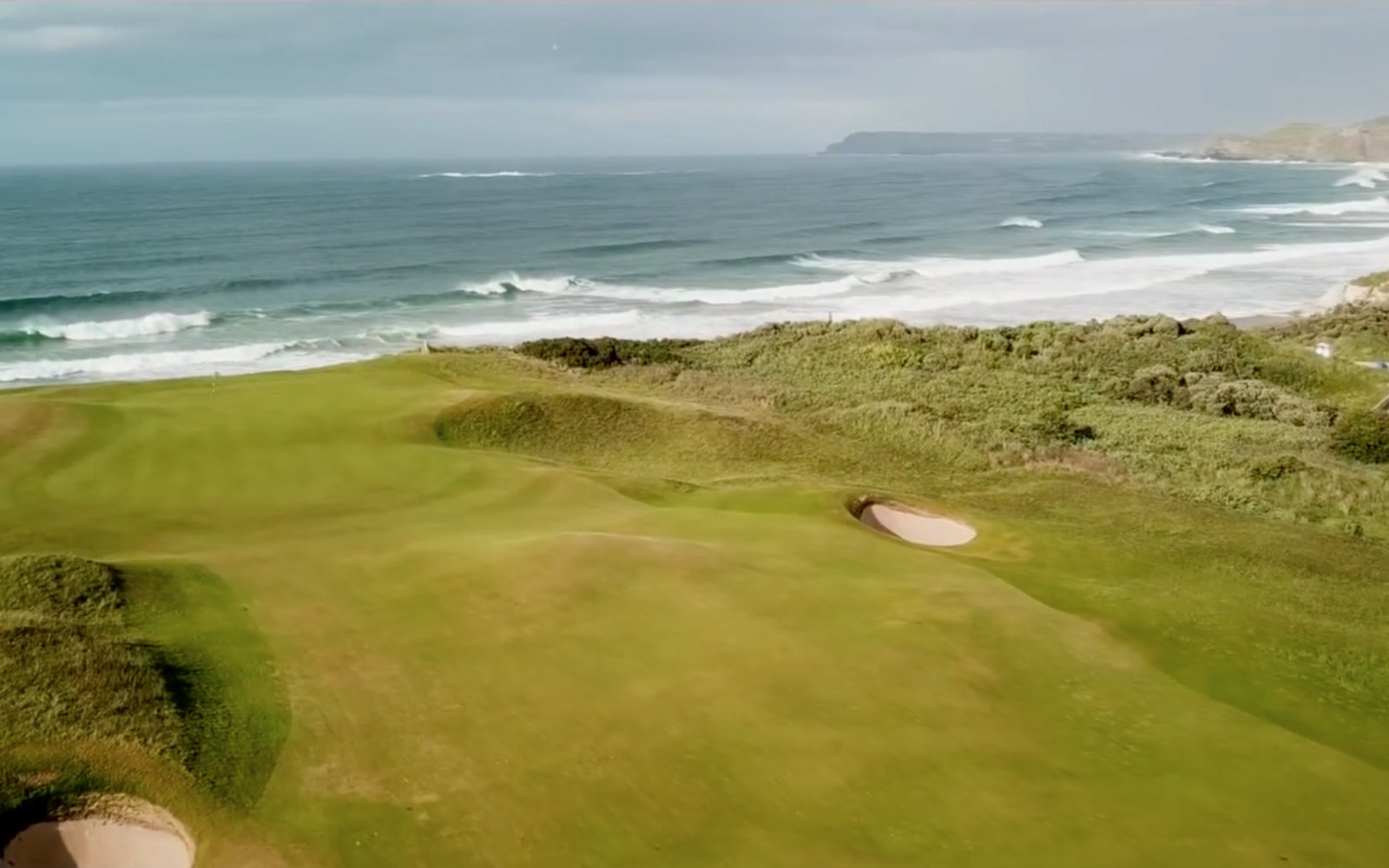
Harry Colt at Portrush and Newcastle: One Architect, Two Masterworks
Harry Colt's work at Royal Portrush (1932) and Royal County Down (revised 1920s) are the two most-discussed designs in Irish golf. The piece takes them together — the same architect's hand on different ground — and asks what they share and what the ground forced apart.
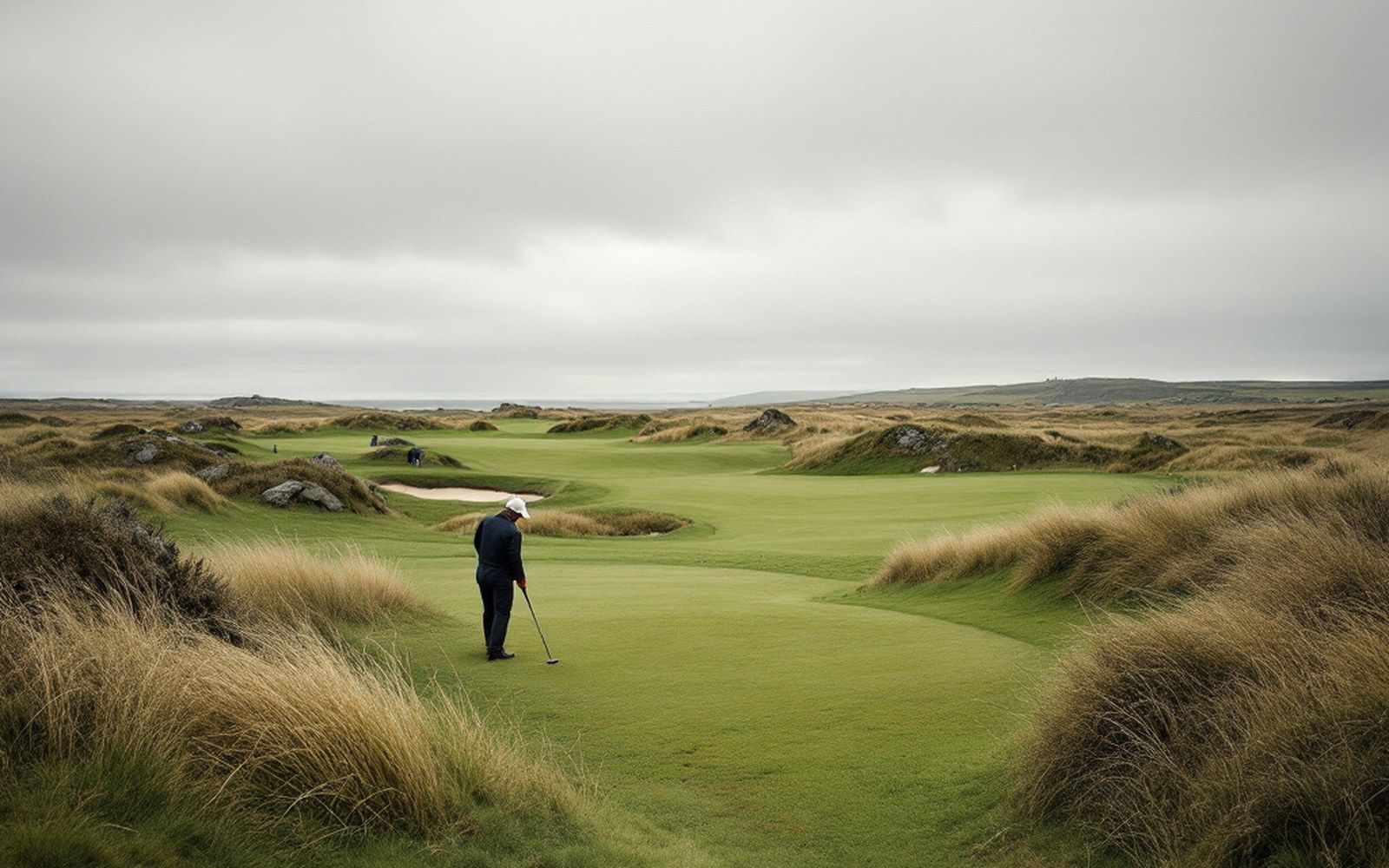
One architect, two pieces of ground that would not agree.
The same architect shaped Ireland's two most celebrated links. The ground he was given could hardly have been more different.
Two Courses, One Hand
Harry Colt came to Portrush in 1929, was retained to oversee the redesign, and by 1932 had produced the Dunluce Links in substantially the form it holds today. His work at Royal County Down in Newcastle belongs to the same decade — revisions to a course that Old Tom Morris had first laid out in 1889, Colt's brief being to tighten and formalise a layout the expanding club had outgrown. The two commissions ran close enough together that the same sensibility governs both, yet they produced courses that feel, in the ground, almost nothing alike.
What the courses share is restraint. Colt — a solicitor turned architect, co-founder of the firm that became Colt, Alison and Morrison — designed with topography rather than against it. His published writing makes clear his conviction that the architect's role was to reveal what the land already contained, not to impose a foreign geometry. Both Dunluce and Newcastle are demonstrations of that principle, carried out on ground that rewarded it extraordinarily well.
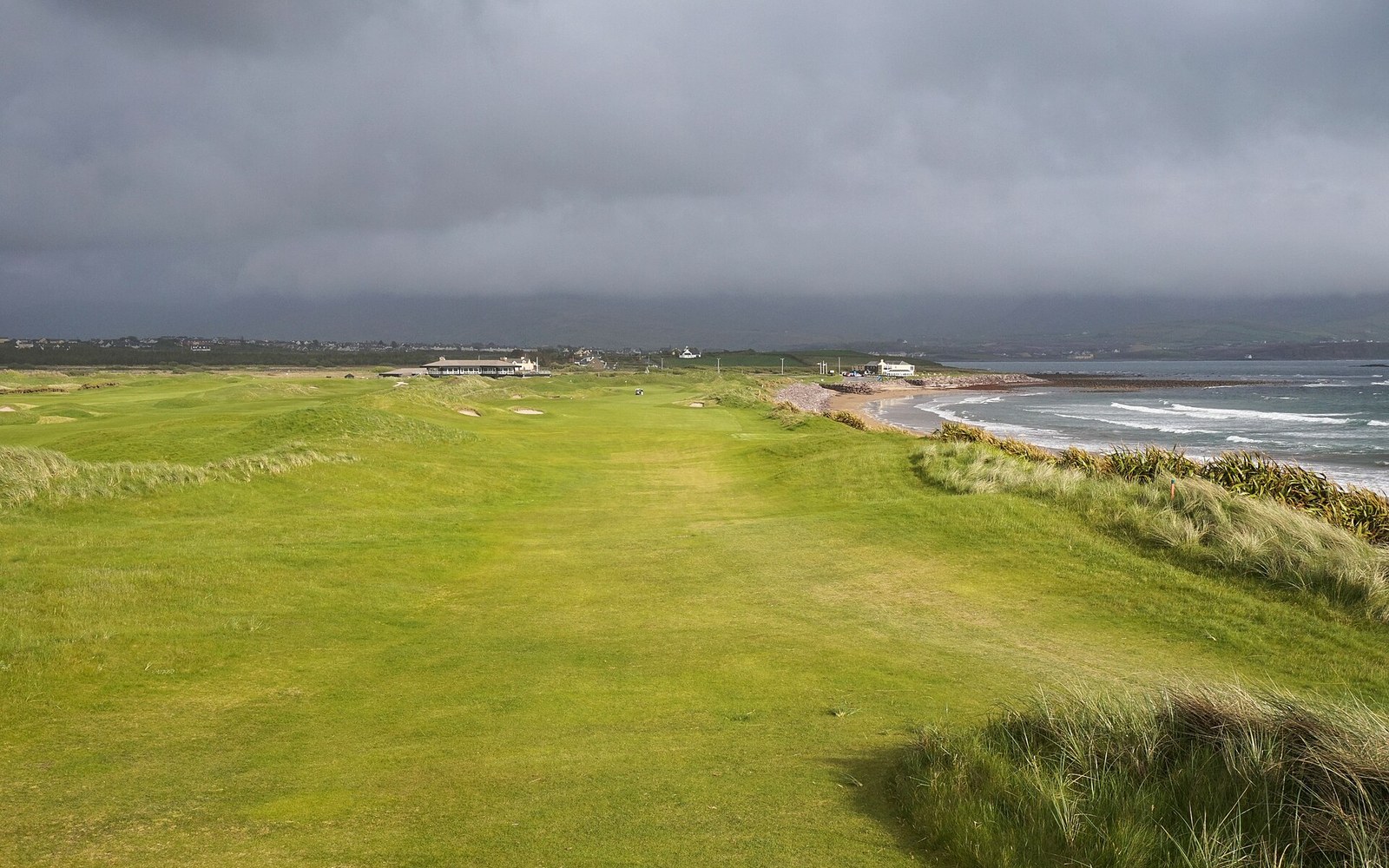
Forty years of Irish links, mostly on very little money. Marram-fringed, revetted, and among the most expensive things on the course to keep.
Photo: Waterville Golf Links - 18th hole · Wikimedia Commons · Photo: Royal County Down Golf Club-geograph-4029611-by-Eric-Jones · Wikimedia Commons
What the Ground Did
At Portrush, Colt worked with a narrow dune corridor running roughly east along the Antrim coast, the land squeezed between the town and the sea. The dunes here are pronounced but not mountainous, and the routing has a linear logic imposed partly by the site's width. What Colt made of that constraint is a sequence of holes that use the ridgelines as natural baffles — greens set in hollows or raised on plateaux so that distance control becomes inseparable from trajectory. The par-three Calamity Corner, the fourteenth, drops away to the right with a fall of roughly seventy feet to White Rocks beach below; it requires not just accuracy but a precise understanding of what a crosswind will do to a ball carrying across open air above the cliff edge. That hole is Colt's most cited in Ireland, and it earns its reputation.
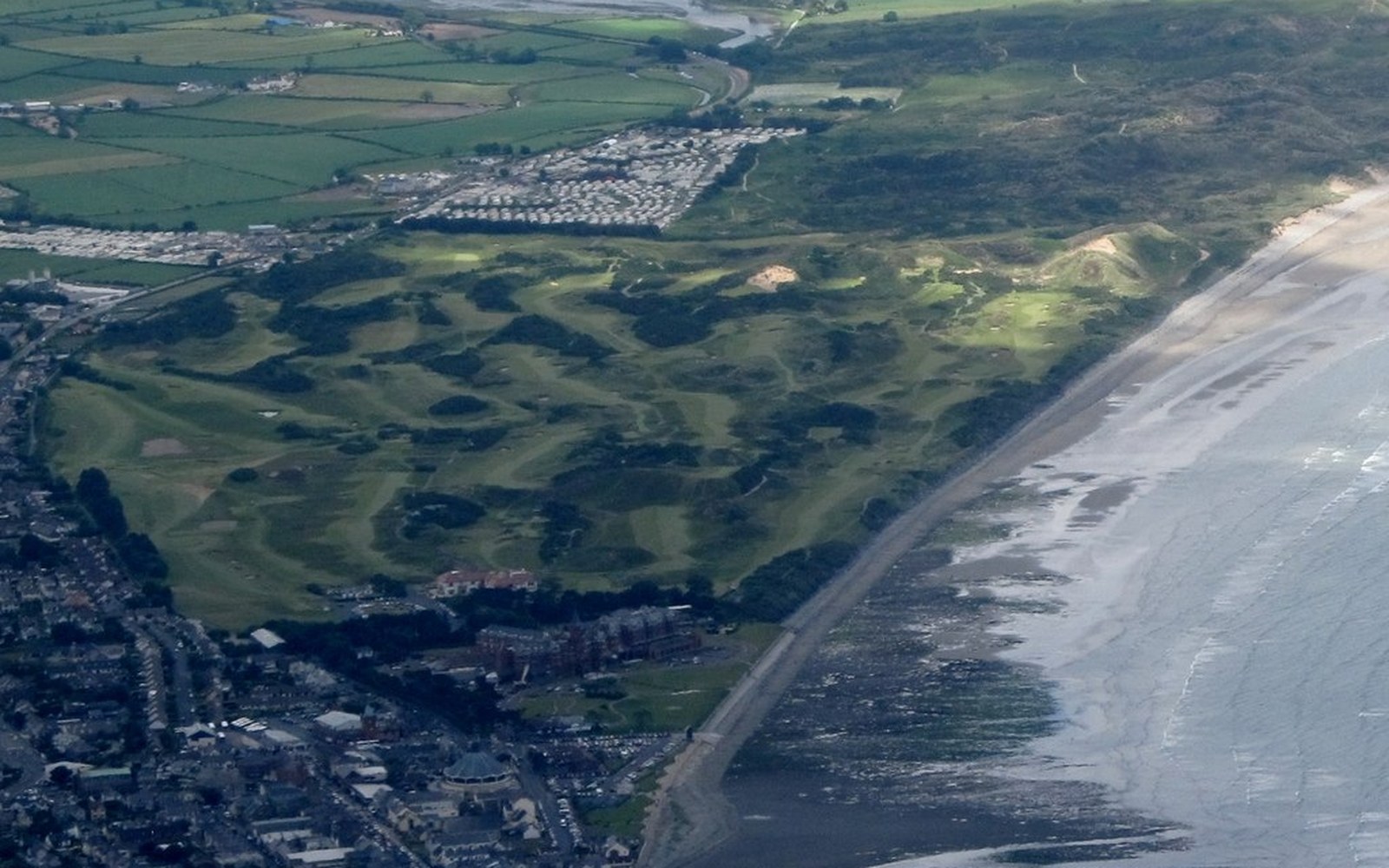
Newcastle gave him something rawer. The Mourne Mountains rise immediately behind the course, and the dunes at Royal County Down are among the largest in these islands — massive, irregular humps that would have defeated a lesser architect by making coherent routings almost impossible. Colt's revisions, carried through the 1920s, imposed connectivity onto a landscape that resisted it. The fairways thread through the dune ridges rather than running alongside them, so the golfer is perpetually inside the topography, not surveying it. The Geological Survey of Northern Ireland documents the dune systems along this coast as among the most dynamic on the island, and the sheer scale of the sandhills Colt was working with at Newcastle is visible in historical photographs from that period.
The greens at Royal County Down tend to sit in amphitheatres formed by the dunes themselves — natural frames that Colt chose not to disturb, aligning the approach angles to use the encircling ridgelines as both backdrop and penalty. At Portrush the greens are more openly sited, exposed to the sea wind in ways that make the same shot play entirely differently on consecutive days.
What an Architect Leaves Behind
Both courses went on to host championships that tested whether Colt's layouts had real depth. Royal Portrush Golf Club hosted the Open Championship in 1951 and again in 2019, requiring only a two-hole alteration by Martin Hawtree at the northern edge of the property to accommodate modern fields and television infrastructure — a modification Colt could not have anticipated but one that left his core routing untouched. Royal County Down hosted the Amateur Championship and has appeared repeatedly on global course rankings near the summit; the R&A has signalled it as an Open venue, the ground logistics being the principal obstacle rather than any insufficiency in the course itself.
What separates the two is ultimately what separated the ground: Portrush is a links of control, where the architecture channels and the wind disorients; Newcastle is a links of exposure, where the architecture barely contains a landscape that is always pressing back. That Colt produced a masterwork on each says something precise about the difference between a talented architect and an exceptional one. The talent draws from a method; the exception draws from the land in front of him.