Eddie Hackett: Forty Years of Irish Links on Almost No Money
Eddie Hackett designed or revised more Irish links courses than anyone else, often with very small budgets and on ground that rewarded following rather than reshaping. The piece covers his full body of work — Carne, Connemara, Enniscrone and the rest — as a consistent design philosophy rather than a list of venues.
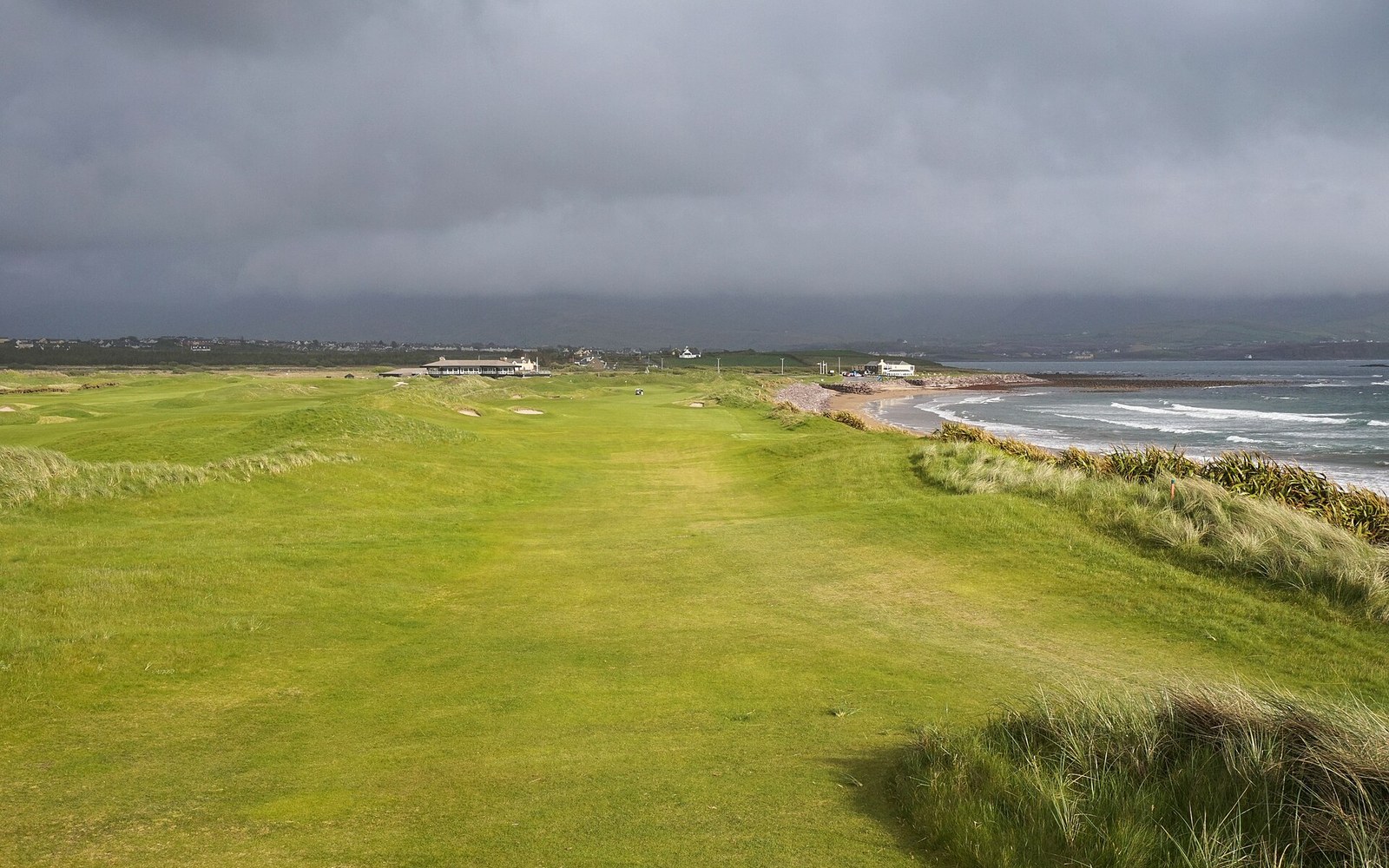
Forty years of Irish links, mostly on very little money.
Photo: Waterville Golf Links - 18th hole · Wikimedia Commons
The Architect Nobody Hired for His Reputation
Eddie Hackett did not arrive on a commission with a design team, a soil laboratory, or an earthmoving budget. He arrived, most often, in a small car, having driven from Dublin to a stretch of County Mayo coastline or a wind-battered peninsula in Connemara where a local committee had scraped together barely enough to pay for the routing, let alone the construction. What he found in those places — dunes of prodigious scale, natural corridors, ground that had been shaped by Atlantic weather across millennia — he treated with a consistent instinct: follow, do not impose.
That instinct produced more Irish links courses than any other architect in the twentieth century. From the late 1960s through to his death in 1996, Hackett worked on Carne at Belmullet, Connemara Golf Club at Ballyconneely, Enniscrone in County Sligo, Waterville on the Iveragh Peninsula, land at Barrow on the Dingle Peninsula that later became Tralee, and a string of inland and seaside courses that together constitute the most geographically dispersed architectural legacy in Irish golf. He was, in practical terms, the state's de facto links architect during a period when almost no one else was building on that ground.
A Philosophy Built on Scarcity
The budgets were not incidental to the work — they were constitutive of it. Hackett could not afford to move ground, so he read it. At Carne at Belmullet, working in the late 1980s and early 1990s on some of the largest dune topography in Ireland, he routed holes through valleys between ridges that were, in places, thirty metres high. Heavy machinery would have flattened what made the land extraordinary. Instead, greens were positioned where the land already offered a natural platform, and fairways were threaded where the dunes already admitted passage. The course that resulted is among the most topographically dramatic in Ireland, not because Hackett shaped it, but because he largely left it alone.
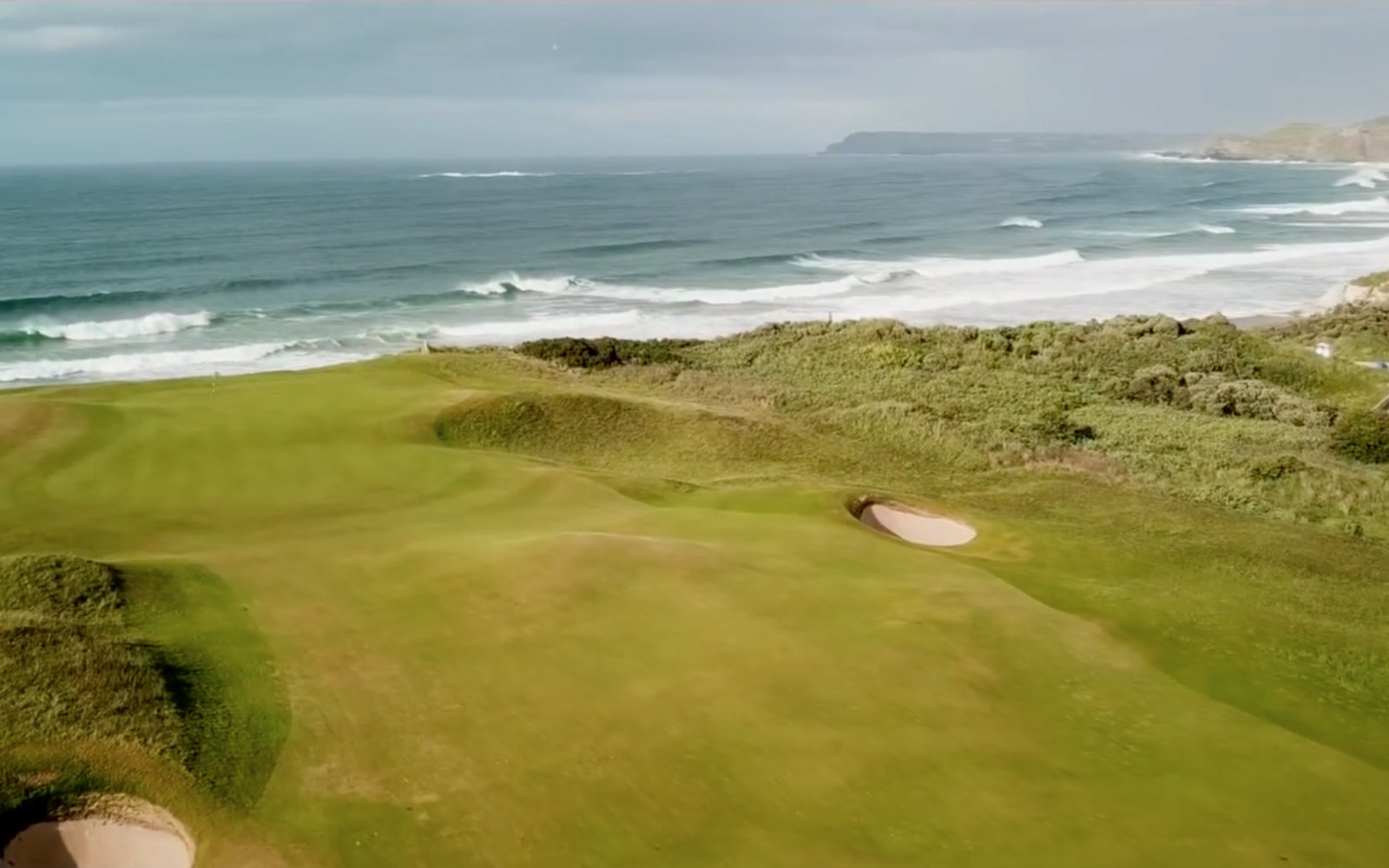
Dunes the club had never routed through. Grazing beside the first.
Photo: Royal Portrush Golf Club 5th hole · Wikimedia Commons · Photo: Becky L / Pexels
The same logic held at Enniscrone, on the County Sligo coast south of Killala Bay, where dune ridges run inland in parallel corrugations and the routing drops into hollows that read, in play, as natural amphitheatres. Hackett found lines that turned terrain constraints into strategic features — a blind tee shot into a valley is punishing if the approach is misjudged, and that punishment is purely a product of ground that preceded the architect by centuries. Whether or not the course has been subsequently modified, the underlying principle of minimum intervention remained his signature.
At Connemara, the land is different in character: lower, more exposed, boggy at the margins, with Twelve Bens visible to the east and the Atlantic setting the western boundary. The course is built on ground that is partly links in character and partly moorland, and Hackett's routing respects the transition without trying to homogenise it. The result is a course that feels genuinely site-specific — which, on a small budget, it had to be.
Waterville and the Question of Credit
Waterville complicates the tidy narrative. The club's land on the Iveragh Peninsula has held golf since the early twentieth century, and the modern layout is a product of layered revision in which Hackett's role intersects with that of others. His work there in the 1970s shaped much of the inland and mid-course routing, but Waterville's championship-standard length and its reputation as a serious test owe something to subsequent refinements and, more significantly, to the exceptional quality of the terrain itself. Ballinskelligs Bay and the surrounding mountains provide a setting that lifts any competent routing. Hackett's competence here was considerable; the credit, as at most of his courses, is distributed between man and ground.
The same caution applies to Tralee. The Barrow site on the Dingle Peninsula that would eventually become Arnold Palmer's 1984 design was land Hackett had surveyed and considered. The commission ultimately went to Palmer, producing the only links in Europe bearing his name. What Hackett identified in that ground — its cliff edges, its dune runs, its relationship to the sea — was real regardless of who signed the final drawings.
Minimalism as Method, Not Ideology
It would be wrong to frame Hackett's approach as consciously minimalist in the architectural-theory sense that American writers applied to the term from the 1990s onwards. He was not positioning himself in a debate about design philosophy. He was working within hard material limits and making pragmatic decisions that happened to align with what better-resourced architects elsewhere were arguing was the right approach. The results look like minimalism because poverty is a reliable teacher of restraint.
What Hackett understood, practically, was that the ground on Ireland's Atlantic coast does not require improvement in the way that a featureless inland site might. The Ammophila arenaria — marram grass — that stabilises the dunes is already doing structural work before a routing exists. The fescue that will eventually define the playing surfaces wants dry, low-nutrient conditions that the coastal climate provides without irrigation. Cutting into a dune ridge to insert a green is not just expensive; it is usually wrong, because it interrupts the hydrological and botanical systems that make the surface playable without intensive management. Hackett's courses are, as a consequence, among the lower-maintenance links in Ireland, which on budgets that have rarely been generous, matters.
Marram-fringed, revetted, and among the most expensive things on the course to keep.
Photo: Royal County Down Golf Club-geograph-4029611-by-Eric-Jones · Wikimedia Commons
The Legacy and Its Gaps
Hackett left no published design treatise, no office archive of the kind that Harry Colt's practice maintained, no collected correspondence with clients that historians can now work through. The R&A's Golf Course 2030 sustainability framework might, if applied retrospectively as a measure, show that his courses score well on chemical reduction and habitat preservation — not because he anticipated those criteria, but because he couldn't afford the chemicals and had no incentive to disturb the habitat. The framework was not his, but the outcomes align.
What the gaps in the record mean is that attribution at several courses remains contested or imprecise — local committees' memories of who drew what, and when, are not always consistent with the physical evidence of what was actually built. The Geological Survey Ireland's published coastal data on Atlantic coast erosion rates adds a further complication: some of the holes Hackett routed closest to the dune edge have since been modified or lost as the shoreline retreated. The course he built and the course that now exists are not always the same thing, and the difference between them is partly the Atlantic's work.
Forty years, almost no money, and ground that did most of the heavy lifting: Hackett's legacy is inseparable from the landscape it occupies, which is exactly what he intended.